¶ 1. Overview
The Trial Balance Report provides a complete snapshot of the firm’s general ledger balances for a defined reporting period. It is used for:
- Month‑end and year‑end financial reconciliation
- Verifying that debits and credits are balanced
- Reviewing account activity across the fiscal year
- Supporting financial statement preparation
- Identifying unusual account movements or variances
The report displays each account’s opening balance, current‑year activity, closing balance, and percentage change.
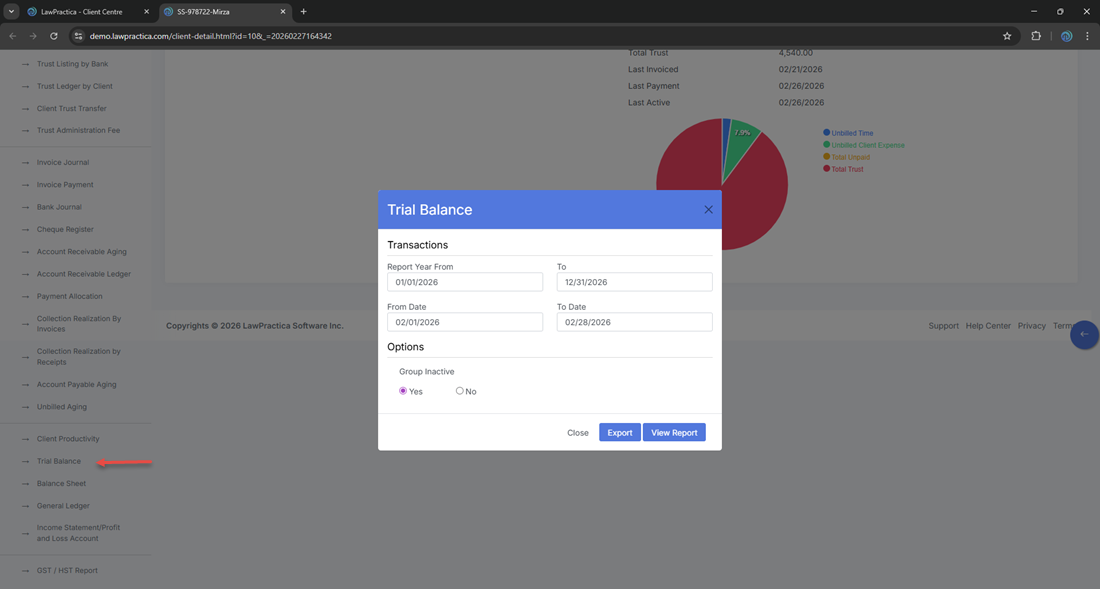
¶ 2. Report Filters (Modal Window)
¶ 2.1 Report Year
- Defines the fiscal year range used to calculate opening and current‑year balances.
- From: 01/01/2026
- To: 12/31/2026
¶ 2.2 Date Range
- Defines the specific period within the fiscal year for which activity is included.
- From Date: 02/01/2026
- To Date: 02/28/2026
¶ 2.3 Options
- Group Inactive: Yes / No When enabled, inactive accounts are grouped together for cleaner reporting.
¶ 2.4 Actions
- View Report
- Export
- Close
¶ 3. Report Output
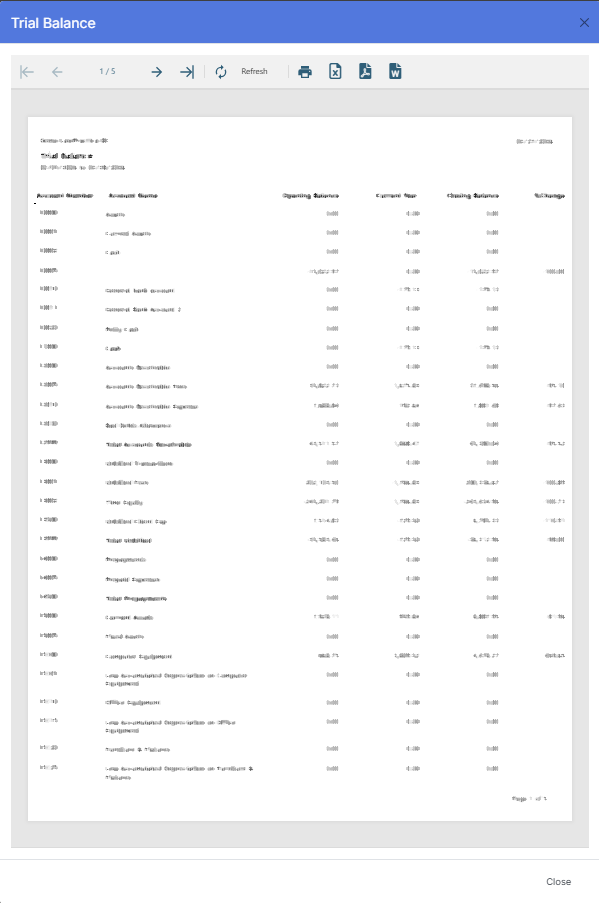
¶ 3.1 Header Information
Displayed at the top of the report:
- Firm Name: Demo‑LawPractica‑BC
- Print Date: 02/27/2026
- Report Title: Trial Balance
- Date Range: 02/01/2026 to 02/28/2026
¶ 3.2 Report Columns
| Column | Description |
|---|---|
| Account Number | General ledger account number |
| Account Name | Name of the GL account |
| Opening Balance | Balance at the start of the fiscal year or reporting period |
| Current Year | Total activity posted during the fiscal year up to the selected date |
| Closing Balance | Ending balance after applying current‑year activity |
| % Change | Percentage change between opening and closing balances |
These fields provide a complete financial snapshot of each GL account.
¶ 4. Export Options
Available formats:
- Excel
- CSV
Exports preserve account ordering and balance calculations.
¶ 5. Best Practices
- Use the report during month‑end to confirm GL accuracy before closing.
- Review % Change to identify unusual account fluctuations.
- Compare Opening vs. Closing Balance to validate year‑to‑date postings.
- Enable Group Inactive to focus on active accounts only.
- Export to Excel for deeper financial analysis or audit preparation.
- Use the report alongside the General Ledger Detail for transaction‑level investigation.
¶ 6. Summary
The Trial Balance Report provides a consolidated view of all general ledger accounts, showing opening balances, current‑year activity, closing balances, and percentage changes. It is essential for reconciliation, financial reporting, and ensuring the integrity of the firm’s accounting records.